Autonomous Machine Intelligence Lab

Building autonomous intelligence that learns, collaborates, and acts.

We develop reinforcement learning, multi-agent, and embodied AI systems for adaptive and self-improving real-world intelligence.

School of AI Convergence · Sungshin Women's University

About the Lab

Autonomous, collaborative, and embodied intelligence.

AMI Lab studies autonomous machine intelligence with a focus on reinforcement learning, multi-agent systems, self-improving agents, and embodied AI. We aim to build intelligent systems that can learn efficiently from experience, collaborate with others, recognize their own uncertainty, actively seek information, and act meaningfully in the physical world.

Our work spans the foundations of decision-making and the integration of foundation models — LLMs, VLMs, and VLAs — into agents that can reason, communicate, and operate across real-world environments. We collaborate with partners across academia and industry, and welcome motivated students who want to engage with research from first principles.

  • Reinforcement Learning
  • Multi-Agent Systems
  • Self-improving Agents
  • Embodied AI

Research

Our research areas.

From multi-agent collaboration to self-reflective reasoning — building agents that learn, communicate, and act with purpose.

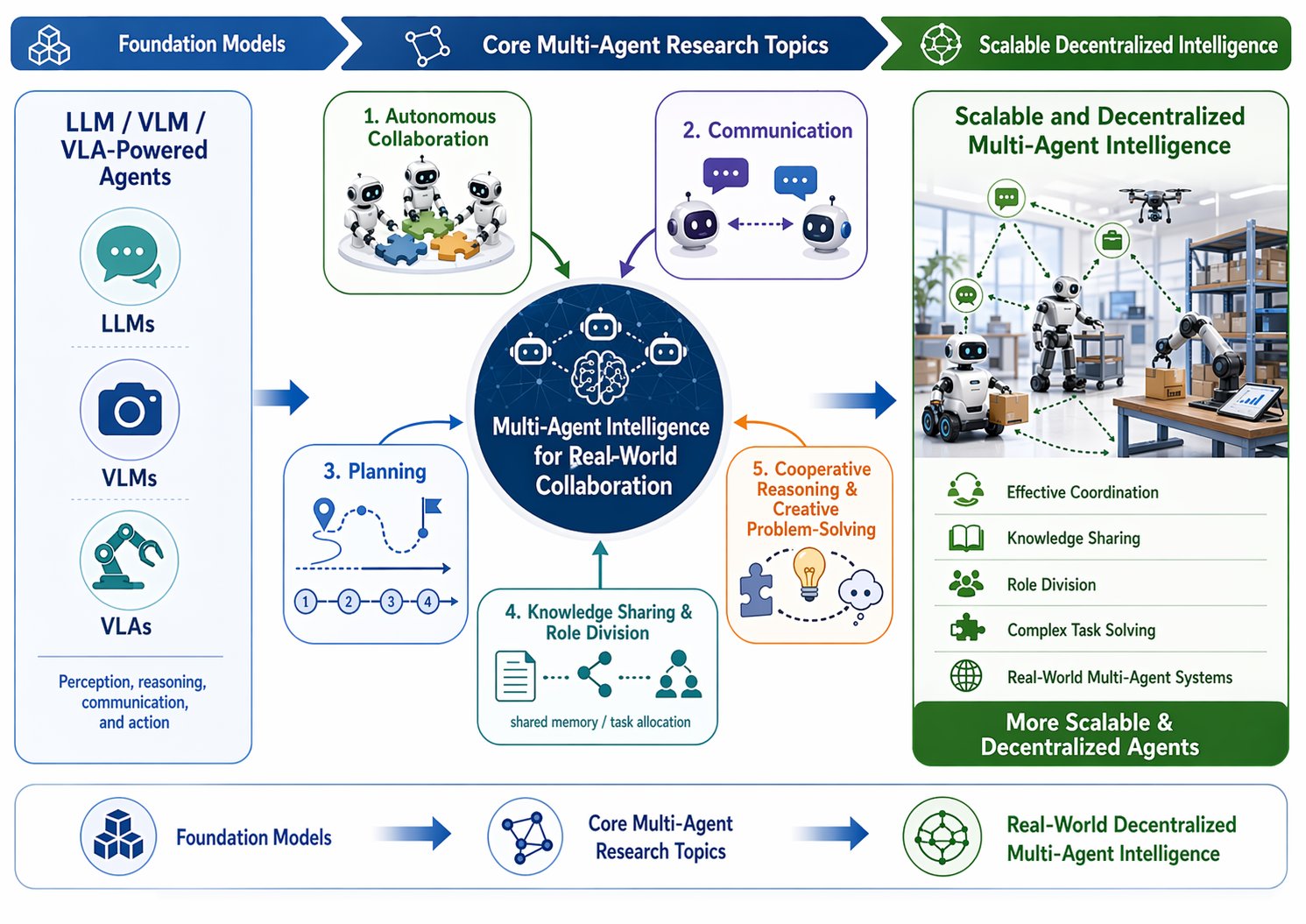
Multi-Agent Systems diagram
01 / 멀티 에이전트 시스템

Multi-Agent Systems

Collaborative, communicative, and goal-driven intelligence for multi-agent systems.

We investigate autonomous collaboration, communication, and planning in multi-agent systems powered by LLMs, VLMs, and VLAs. Our research aims to develop agents that can coordinate effectively, share knowledge, divide roles, and solve complex tasks through cooperative reasoning. We are particularly interested in scalable and decentralized multi-agent intelligence for real-world environments.

  • multi-agent collaboration
  • communication
  • planning
  • decentralized intelligence
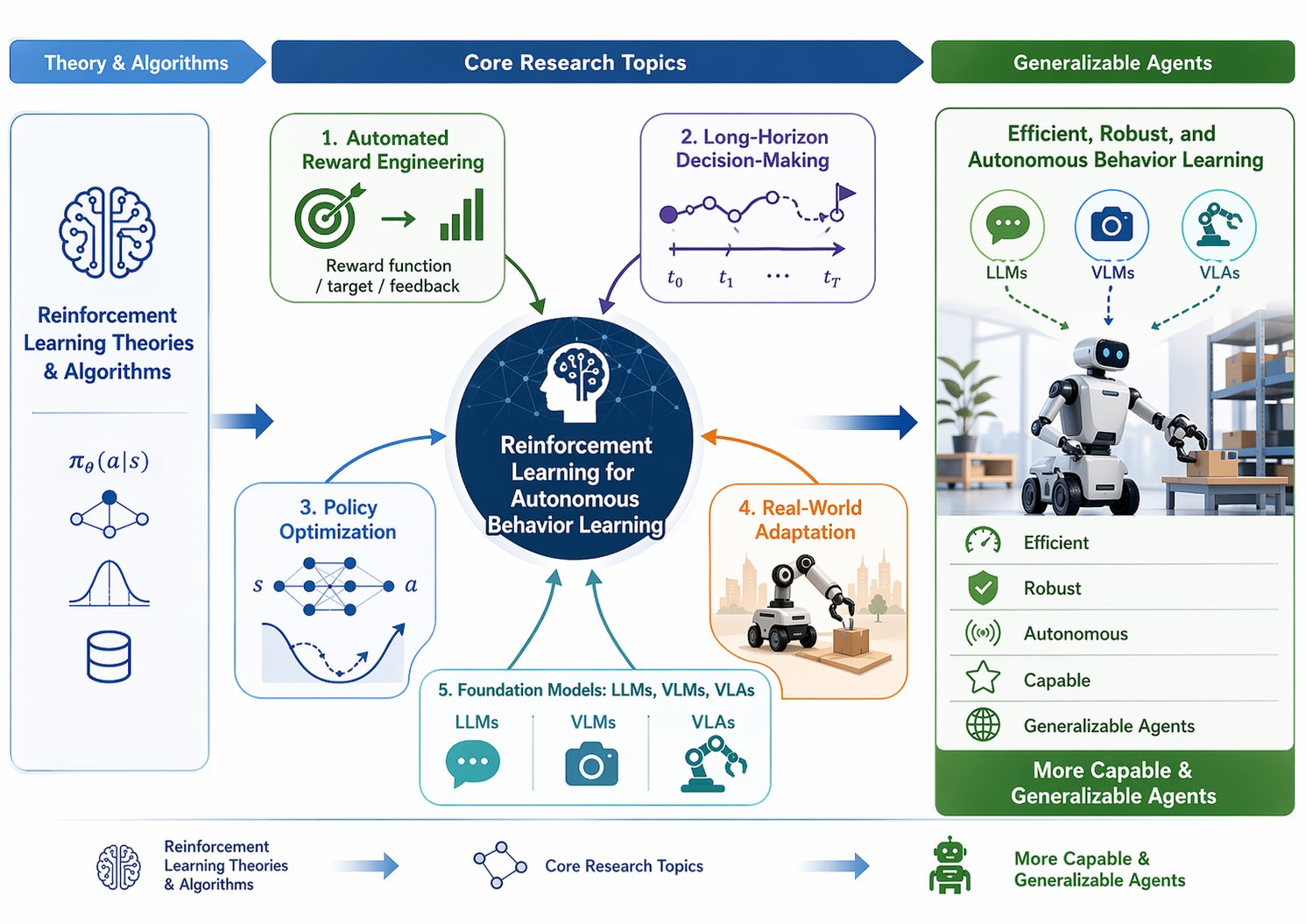
Reinforcement Learning diagram
02 / 강화학습

Reinforcement Learning

Data-efficient and adaptive learning for autonomous agents.

We study RL theories and algorithms for efficient, robust, and autonomous behavior learning. Our focus areas include automated reward engineering, long-horizon decision-making, policy optimization, and real-world adaptation. We also explore RL combined with large foundation models — LLMs, VLMs, and VLAs — to enable more capable and generalizable agents.

  • reward learning
  • long-horizon planning
  • policy optimization
  • foundation-model-enhanced RL
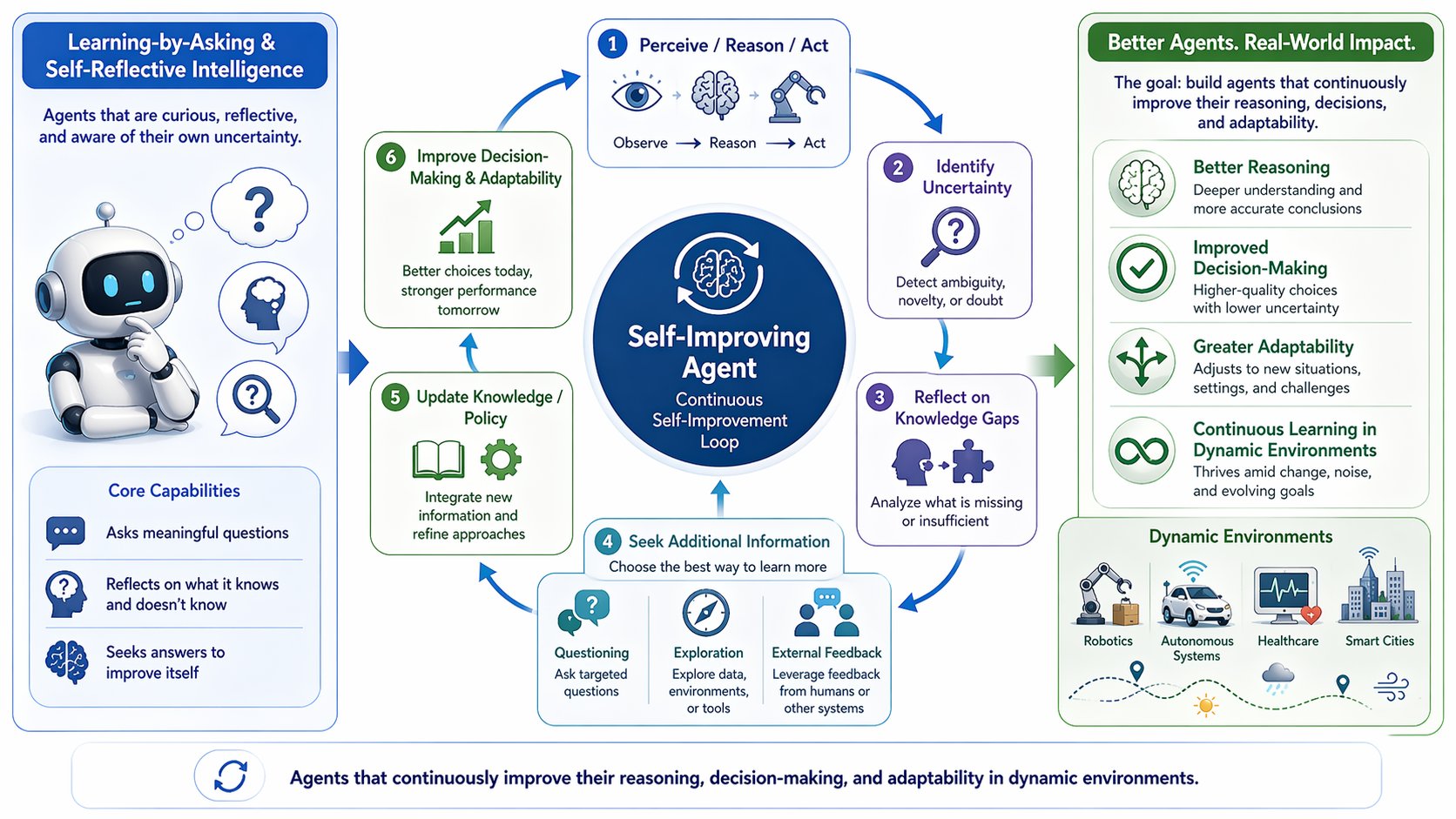
Self-improving Agents diagram
03 / 자기 개선 에이전트

Self-improving Agents

Agents that improve themselves by recognizing uncertainty and asking questions.

We study agents that identify their own uncertainty, reflect on their knowledge gaps, and actively seek additional information through questioning, exploration, or external feedback. Inspired by learning-by-asking and self-reflective intelligence, our goal is agents that continuously improve their reasoning, decision-making, and adaptability in dynamic environments.

  • learning-by-asking
  • uncertainty awareness
  • self-reflection
  • LLM / VLM
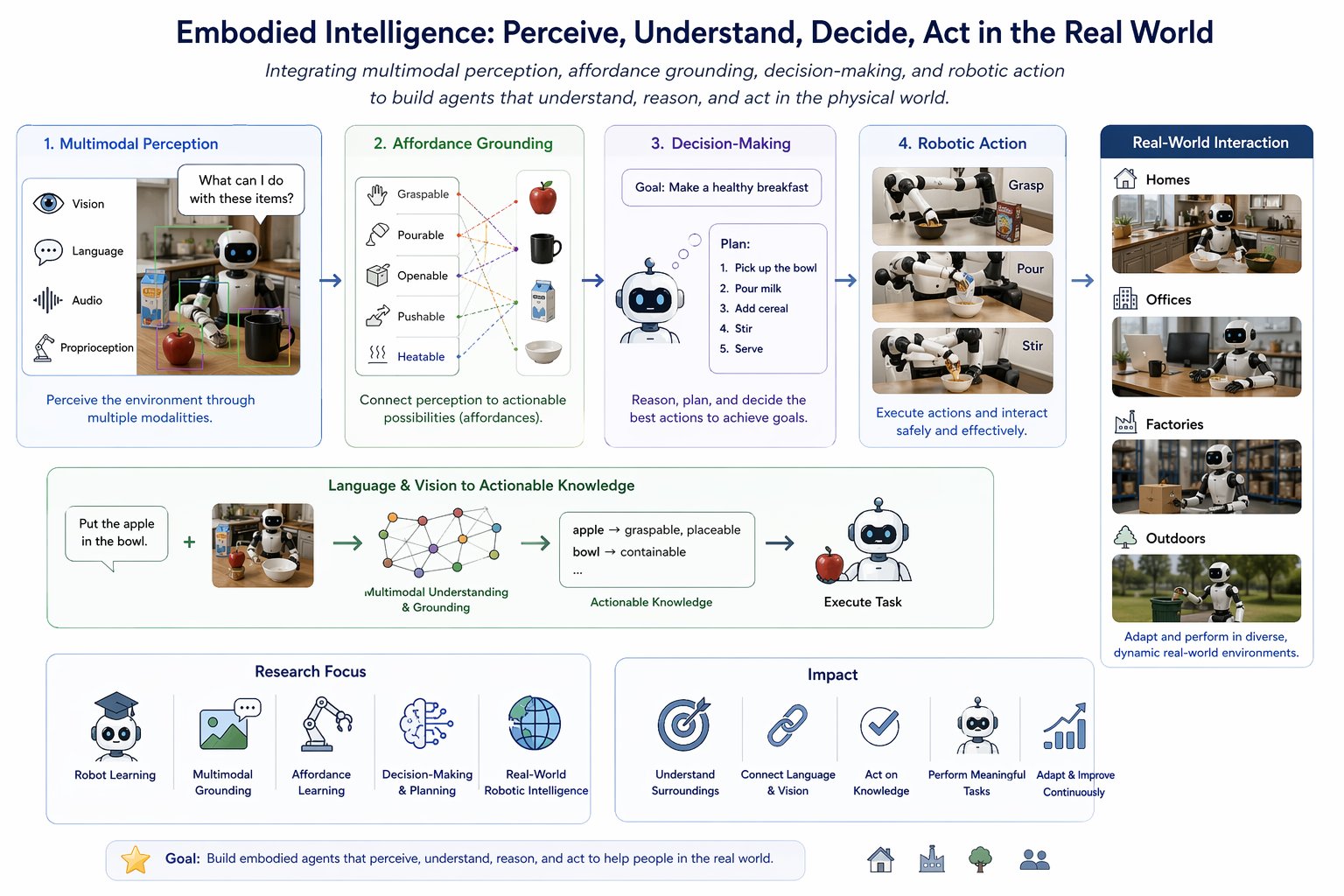
Embodied AI diagram
04 / 체화 인공지능

Embodied AI

Agents that perceive, reason, and act in the physical world.

We explore embodied intelligence by integrating multimodal perception, affordance grounding, decision-making, and robotic action in real-world environments. Our research addresses how agents can understand their surroundings, connect language and vision to actionable knowledge, and perform meaningful tasks through physical interaction.

  • robot learning
  • multimodal perception
  • affordance
  • multimodal grounding

Publications

Selected research output.

2026

2025

  • Junseok Park, Hyeonseo Yang, Min Whoo Lee, Won-Seok Choi, Minsu Lee, Byoung-Tak Zhang
    IEEE Transactions on Cognitive and Developmental Systems
    Int'l Journal
  • Youwon Jang, Woo Suk Choi, Minjoon Jung, Minsu Lee, Byoung-Tak Zhang
    EMNLP 2025
    Int'l Conference
  • Ganghun Lee, Minji Kim, Minsu Lee, Byoung-Tak Zhang
    AAAI 2025
    Int'l Conference
  • Sua Kang, Chaelim Lee, Subin Jung, Minsu Lee
    Electronics
    Int'l Journal
  • Woo Suk Choi, Youwon Jang, Minsu Lee, Byoung-Tak Zhang
    Knowledge-Based Systems
    Int'l Journal
  • CraftGround: A Flexible Reinforcement Learning Environment Based on the Latest Minecraft
    Hyeonseo Yang, Minsu Lee, Byoung-Tak Zhang
    Journal of KIISE (정보과학회 논문지)
    Domestic Journal
  • Multimodal Generative Framework for Korean-style Adaptation of Foreign Fairytales
    Hanbi Choi, Dohee Kim, Yuri Kim, Heejae Shin, Minsu Lee
    Korea Computer Congress 2025 (한국컴퓨터종합학술대회)
    Domestic Conference
  • Worldbuilding Character Chatbot via RAG and Prompt Engineering
    Sua Kang, Chaelim Lee, Subin Jung, Minsu Lee
    Korea Computer Congress 2025 (한국컴퓨터종합학술대회)
    Domestic Conference
  • Imitation Learning with Echo State Networks for Robotic Manipulation
    Youngseok Joo, Suhyung Choi, Wooyul Jung, Minsu Lee, Byoung-Tak Zhang
    Korea Computer Congress 2025 (한국컴퓨터종합학술대회)
    Domestic Conference
  • Comparison of SDV Autonomous Driving Simulation Virtual Validation Performance through Cloud-based PPO Learning
    Jeonga Choi, Minsu Lee, Jonggu Kang
    Korea Computer Congress 2025 (한국컴퓨터종합학술대회)
    Domestic Conference
  • Recency-Biased Sampling for Up-to-Date Adaptation of Reinforcement Learning
    Ganghun Lee, Minji Kim, Minsu Lee, Byoung-Tak Zhang
    Korea Software Congress 2025 (한국소프트웨어종합학술대회)
    Domestic Conference
  • Heuristic Action Cycle Reinforcement Learning
    Minji Kim, Ganghun Lee, Minsu Lee, Byoung-Tak Zhang
    Korea Software Congress 2025 (한국소프트웨어종합학술대회)
    Domestic Conference
  • Implementation of a Liquid State Machine Framework for Robotic Imitation Learning
    Youngseok Joo, Wooyul Jung, Suhyung Choi, Minsu Lee, Byoung-Tak Zhang
    Korea Software Congress 2025 (한국소프트웨어종합학술대회)
    Domestic Conference

2024

Patents

People

The people of AMI Lab.

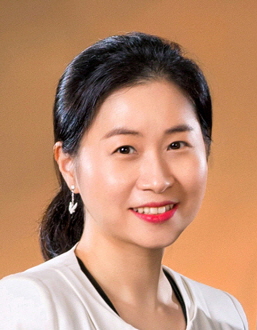
Prof. Minsu Lee

Principal Investigator

Minsu Lee 이민수

Assistant Professor · School of AI Convergence, Sungshin Women's University

Prof. Lee leads the Autonomous Machine Intelligence (AMI) Lab. Her research advances autonomous, collaborative, and embodied intelligence — from foundational reinforcement learning to multi-agent systems and self-improving agents grounded in foundation models.

Self-improving AI · Reinforcement Learning · Multi-Agent Collaboration & Communication · Multimodal Intelligence · Embodied Intelligence

Master's Course Students

  • Hanbi Choi 최한비
    Multi-Agent Collaboration · VLM-based Transfer Learning
  • Seyeon Jung 정세연
    Multi-Agent Communication · LLM-based Multi-Agentic Systems

Combined B.S. & M.S. Course Students

  • Heejae Shin 신희재
    Multi-Agent Collaboration · Culture-aware Text Style Transfer
  • Dohee Kim 김도희
    Emergent Tool Generation for Embodied Agents · VLM-based Transfer Learning · Culture-aware Image Style Transfer

Undergraduate Interns

  • Subin Jung 정수빈
    Emergent Tool Generation for Embodied Agents · Persona-driven Chatbot Systems · LLM-based Agentic Systems
  • Suyeon Kim 김수연
    Multi-Agent Communication · LLM-based Agentic Systems
  • Dain Lim 임다인
    Emergent Tool Generation for Embodied Agents · VLM-based Planning for Embodied Agents
  • Nayoung Kim 김나영
    Multi-Agent Communication · LLM-based Agentic Systems
  • Sewon Jung 정세원
    Multi-Agent Collaboration · VLM-based Planning for embodied agents
  • Sua Kang 강수아
    Persona-driven Chatbot Systems · LLM-based Agentic Systems
  • Yuri Kim 김유리
    Culture-aware Text Style Transfer · LLM-based Agentic Systems
  • Chaelim Lee 이채림
    Persona-driven Chatbot Systems · LLM-based Agentic Systems

Teaching

Courses taught.

2026 · Spring

Spring 2026
AI Service Design
Spring 2026
Python Programming

2025

Fall 2025
Machine Learning
Fall 2025
Data Structures and Programming Practice
Spring 2025
AI Service Design
Spring 2025
Python Programming

2024

Fall 2024
Data Structures and Programming Practice
Fall 2024
Digital Logic Circuit
Fall 2024
AI & Design

Funded Research

Active and recent grants.

  • May 2024 – Apr 2027
    Bio-inspired Autonomous Reinforcement Learning for Real-World Applications
    Principal Investigator · NRF · Ministry of Science and ICT
    Ongoing
  • Mar 2026 – Feb 2027
    Automated Reward Function Generation Framework for Adaptive Reinforcement Learning
    Principal Investigator · Sungshin Women's University
    Ongoing
  • Apr 2022 – Dec 2026
    Development of Uncertainty-aware Agents Learning by Asking Questions
    Co-Principal Investigator · IITP · Ministry of Science and ICT
    Ongoing
  • Mar 2025 – Feb 2026
    Heuristic Intervention for Balancing Exploration and Guidance in Reinforcement Learning
    Principal Investigator · Sungshin Women's University
    Completed
  • Apr 2022 – Dec 2023
    Self-directed AI Agents with Problem-solving Capability
    Leading Researcher · IITP · Ministry of Science and ICT
    Completed
  • Mar 2021 – Feb 2024
    Goal-oriented Self-supervised Reinforcement Learning for Real-World Applications
    Principal Investigator · NRF · Ministry of Science and ICT
    Completed
  • Dec 2018 – Mar 2022
    Imitation Learning from Human Demonstration in VR Environment for Physical Human-Robot Interaction (ILIAS)
    Co-Principal Investigator · KIAT · Ministry of Trade, Industry and Energy
    Completed
  • Jun 2018 – May 2021
    Light-weight Incremental Deep Learning Techniques on Embedded Systems
    Principal Investigator · NRF · Ministry of Education
    Completed
  • Jul 2017 – Dec 2021
    QA Systems for Video Story Understanding to Pass the Video Turing Test
    Leading Researcher · IITP · Ministry of Science and ICT
    Completed

Join Us

Curious, motivated, ready to dig in?

We welcome motivated graduate students and undergraduate interns who are excited to tackle research challenges in AI. We're looking for people who are curious, self-motivated, and eager to engage with hard problems through hands-on experimentation and rigorous thinking.

Graduate students should be interested in research-oriented study and academic publication. Undergraduate interns can gain hands-on experience through paper reading, implementation, and project participation.

Our research areas:

  • Reinforcement Learning
  • Embodied AI
  • Multimodal Intelligence
  • Multi-Agent Collaboration
  • Vision-Language and Agentic AI

To apply: please email your CV, transcript, research interests, and a short introduction to Prof. Minsu Lee.